Saturday, April 2, 2011

Why PGDJMC


Why I Join PGDJMC
               PGDJMC (Post Graduation Diploma In Journalism & Mass Communication).
I join PGDJMC because I want to make my career in journalism. I want to be a news reporter.  To get a right education about journalism & mass communication one must join PGDJMC. Through this diploma course I get a full package of education in Mass Communication, Print Media, Electronic Media, New Cyber media, Advertising, Development communication.. I join this course in August 2010. Now I am on the stage where my course is going to be completing in May and I am in a full confidence to get down in any field of journalism whether it is Print or an Electronic.  The course PGDJMC makes me so confident that I can work with any news channel with full dedication & confidence. I am very lucky to have this course as am able to complete my dream of becoming the journalist.
I advised people who wants to become the journalist please first join the course PGDJMC (post graduation diploma in journalism & mass communication) & I can bet that after getting education from this course anyone can able to stand as a good journalist.

Thursday, March 10, 2011

Importance Of Friendship


Friendship: Good for the Body, Good for the Soul

“Many people will walk in and out of your life; but only true friends will leave footprints in your heart."
FriendsFriends are our truest treasures. How many times have they: Made us laugh when we felt like crying over a bad mistake? Made us feel loved when our boyfriends (or girlfriends) broke up with us? Gave us the courage to go back to school or to change careers? Like armor, good friends make us almost invincible, capable of warding off the blows life occasionally deals us. Because of their steadfastness, we see setbacks for what they are: temporary.
Because friends accept us for who we are, we gain the confidence to dream great dreams—and to make them real. Friends liven up our days with their twisted humor, their honest answers, and their ability to bear our gloating when we beat them at golf or tennis. We can even trust them with our most embarrassing secrets! What a relief it is for us to reveal our true selves to someone!
It’s no wonder, then, that medical researchers have found that those who have friends tend to be happier, healthier, and live longer than those who do not. In fact, friendship has numerous physical and spiritual benefits.

Thursday, February 24, 2011

Money

First of all, believing that "money doesn't grow on trees" is an example of what's called lack or scarcity programming. Our parents taught us that there was never enough money to go around, and that it was not readily available or abundant. But in truth, the universe is very abundant, and there is lots of money to go around for everyone. Just think what you could do if you have so much money how much your heart desires. What wonderful things you could do with it: travel to the countries you have always dreamt of, buy a house you even scared to think about it, attend meditation classes so you could spiritually grow, donate money to your favourite charity, spend more quality time with your family and the list goes on.

The key is to start thinking that you deserve the money and that there is lots of it available for you, and then you can start attracting it into your life. That's abundance thinking, which is the opposite of lack or scarcity thinking. When you start thinking about the abundance the Law of Attraction will do the rest. You do not need to know how it is going to happen just make the first step, first thought. Starting is already winning.

And what about thinking that "money is the root of all evil"? Can you really expect to become a success if you believe that money is the root of all evil? Unless you have a desire to be an evil person, your subconscious will not let you have money if you believe deep down that it is the root of all evil.

By the way, that quote is taken out of context in the first place. It was originally stated as "the love of money is the root of all evil". So it has nothing to do with the money itself.

Wednesday, February 23, 2011

Funny Indian ad about AIDS awareness --Courtroom


The ad is about aids awareness. Through this ad we are knowing about the help given by the different ogranisation or NGOs. They are telling us that one should be clear about each an every answer if the question is about AIDS and one should not be shy.

Virgin Mobile - Changing Room 20sec Hinglish.mpeg


the ad is on Virgin network, telling us about the new calling rates.
the concept of the ad is very clear that after being caught in awkward situation he has  to talk to his friend to clear all the misunderstanding, so for this he needs a virgin network because the calling rates are cheaper.

Very funny Indian ad for Education Times ,TOI - Hair Art


it is the funny ad. the ad is about the right education given to the people.
the ad is clearly showing that if the right education is not given than you will be in a great mess.
it is very necessary to get proper education to get proper job.

Funny Indian ad Hutch Eskimo 2 windows live search MSN


the ad is great and its brings up with the new imagination showing about the live search.
the best part of the ad is its end because till the end the audience were thinking about ,what will be the end.
the ad is on Hutch live search MSN. 

Very Funny Indian Commercial (TV AD) Coool! 3,00,000+ Views!


this ad is being called as the funny Indian commercial ad.
the ad is about the Camlin whitebored marker. the shows that the marker is so effective that when the man writes "change" on the board evryone took out their change (money). It seems that how powerful and impressive the Camlin marker is!

Camlin Marker Funny Indian Commercial Advertisement


this ad is the funniest commercial ever!!
the ad is about the permanent Camlin marker. the ad shows how powerful the marker is that bring back the life of her husband.

Award winning & funny Indian ad for Glycodin


the ad is about  the glycodin cough syrup.
It is the funny ad. In this ad people are going to the priest to name their child,  the priest about to coughs, thety give the priest the Glycodin and the name comes out from his mouth was "glycodin" and they put the name of their child glycodin only.

Tuesday, February 22, 2011

Teacher- The Role Model

The teacher is like an oil lamp if its flame is steady and bight a hundred lamps which can be lit by it without in any way, diminishing its brightness of the lamp, it is necessary that the wick be in good order & the oil supply be sufficient. so,  
The role of a teacher in society is both significant and valuable.It has far-reaching influence on the society he lives in and no other personality can have an influence more profound than that of a teacher. Students are deeply affected by the teacher's love and affection, his character, his competence, and his moral commitment. A popular teacher becomes a model for his students. The students try to follow their teacher in his manners, costumes, etiquette, style of conversation and his get up. He is their ideal.
The  teacher as an architect of our future generations demands that only the best and the most intelligent and competent members of our intelligentsia be allowed to qualify for this noble profession. It is unfortunate to find that generally the worst and the most incapable people of the society find their way into this profession. Anyone who fails to find an opening in any other walk of life, gets into this profession and recklessly plays with the destiny of the nation. An important reason for this is understood to be the poor salaries of our primary and secondary teachers which are no better than that of clerks. A large number of our teachers is , therefore, frustrated and disinterested.

How to present a Public Speech

One of the best tools in mastering communication is listening. Listening to radio programs, watching educational video and programs on television, and listening to others all help people build up vocabulary, understand the proper use of quotations, and identify a variety of styles in public speaking. (Quoting from famous scholars and writers--both ancient and modern--is a useful tool.) Reading also can help, by advancing our knowledge and by reinforcing our comprehension skills.
Following are some important tips for presenting a public speech:
* Always be prepared ahead of time.
* Be organized and prioritize your materials.
* Review the materials a few times.
* Anticipate questions that may be asked.
* Find reasonable answers for those questions.
* Know your audience--to whom are you giving the speech?
* Use your hands and visual aids to emphasize important points.
* Use quotes from famous people.
* Give details and explanations in simple language--colloquially
* Add some flavor to your speech--include humor.
* Speak loudly and clearly.
* Be specific in your ideas.

Science & Technology

The meanings of the terms science and technology have changed significantly from one generation to another. More similarities than differences, however, can be found between the terms.
Both science and technology imply a thinking process, both are concerned with causal relationships in the material world, and both employ an experimental methodology that results in empirical demonstrations that can be verified by repetition Method. Science, at least in theory, is less concerned with the practicality of its results and more concerned with the development of general laws, but in practice science and technology are inextricably involved with each other. The varying interplay of the two can be observed in the historical development of such practitioners as chemists, engineers, physicists, astronomers, carpenters, potters, and many other specialists. Differing educational requirements, social status, vocabulary, methodology, and types of rewards, as well as institutional objectives and professional goals, contribute to such distinctions as can be made between the activities of scientists and technologists; but throughout history the practitioners of “pure” science have made many practical as well as theoretical contributions

Monday, February 21, 2011

Standard of living vs. Quality of life

Standard of living and quality of life are often referred to in discussions about the economic and social well-being of countries and their residents. But what is the difference between the two? The definitions of these terms can be difficult to tease apart and may overlap in some areas, depending on whom you ask. But the difference between the two is more than just semantics; in fact, knowing the difference between the two can affect how you evaluate a country where you might be looking to invest some money.
The main difference between standard of living and quality of life is that the former is more objective, while the latter is more subjective. Standard of living factors, like gross domestic product, poverty rate and environmental quality, can all be measured and defined with numbers, while quality of life factors like equal protection of the law, freedom from discrimination, and freedom of religion are more difficult to measure and are particularly qualitative. Both indicators are flawed, but they can help us get a general picture of what life is like in a particular location at a particular time.

Factors that may be used to measure quality of life include the following:
  • freedom from slavery and torture
  • equal protection of the law
  • freedom from discrimination
  • freedom of movement
  • freedom of residence within one's home country
  • presumption of innocence unless proved guilty
  • right to marry
  • right to have a family
  • right to be treated equally without regard to gender, race, language, religion, political beliefs, nationality, socioeconomic status and more
  • right to privacy
  • freedom of thought
  • freedom of religion
  • free choice of employment
  • right to fair pay
  • equal pay for equal work
  • right to vote
  • right to rest and leisure
  • right to education
  • right to human dignity

Indian Cuisine"s

The Food in India is classified into three major categories. Sattva, Rajas, and Tamas. Satva which stand for balance, Rajas stands for passion, and Thamas stands for indulgence. Food is consumed according to the lifestyle of the person. For Eg: A King has to be aggressive to defend his country, he would be taking food which would give much passion and that aggressiveness which is required. When a person tries to lead his life in want of self realisaiton, he would prefer a Satvic food or known as Sattvic diet, which would help to keep his mind in balance. Thamasic food or known as Static foods is to be taken only if its required, like consumption of Alcohol. This is the reason why in many Indians try to abstain drinking.
The multiple varieties of Indian cuisine are characterized by their sophisticated and subtle use of many Spices and Herbs. Each family of this cuisine is characterized by a wide assortment of dishes and cooking techniques. Though a significant portion of Indian food is vegetarian, many traditional Indian dishes also include: chicken, goat, lamb, fish, and other meats.
India is known for its love for food and spices, and it plays a role in everyday life as well as in festivals. Indian cuisine varies from region to region, reflecting the varied demographics of the country. Generally, Indian cuisine can be split into 5 categories — northern, southern, eastern, western and north-eastern.
Despite this diversity, some unifying threads emerge. Varied uses of spices are an integral part of food preparation, and are used to enhance the flavor of a dish and create unique flavors and aromas. Cuisine across India has also been influenced by various cultural groups that entered India throughout history, such as the Persians, Mughals, and European colonists. Though the tandoor originated in Central Asia, Indian tandoori dishes, such as chicken tikka made with Indian ingredients, enjoy widespread popularity.Indian cuisine is one of the most popular cuisines across the globe Historically, Indian Spices and Herbs were one of the most sought after trade commodities. The Spice trade between India and Europe led to the rise and dominance of Arab traders to such an extent that European explorers, such as Vasco da Gama and Christopher Columbus, set out to find new trade routes with India leading to the Age of Discovery. The popularity of curry, which originated in India, across Asia has often led to the dish being labeled as the "pan-Asian" dish

Bow your hands towards Almighty


Pooja is a part of Indian tradition. However, pooja in the Indian context is not just as simple as reading something from a holy book. All those performing the pooja are involved in the process of worship. This is considered to be a direct way communicating with the god.

Indians have a practice of worshipping god in different forms.


It is said that there are about 30 million forms of god. It is also believed that there is only one sole supreme. There are different schools of worship. Some advocate worshipping the supreme god without a form or a shape since god is considered to be the cosmic power. Others give a form or a shape to the god. It is reflected in the idols they pray. Worshiping Yantras or the algebric forms of mantras encrypted on a variety of surfaces like metal, wood and stone is also a popular form. However, worshiping idols of different gods are the most followed.

Terrorism

Terrorism is the systematic use of terror especially as a means of coercionNo universally agreed, legally binding, criminal law definition of terrorism currently existsCommon definitions of terrorism refer only to those violent acts which are intended to create fear (terror), are perpetrated for a religious, political or ideological goal, deliberately target or disregard the safety of non-combatants (civilians), and are committed by non-government agencies.
Some definitions also include acts of unlawful violence and war. The use of similar tactics by criminal organizations for protection rackets or to enforce a code of silence is usually not labeled terrorism though these same actions may be labeled terrorism when done by a politically motivated group.
The word "terrorism" is politically and emotionally charged,and this greatly compounds the difficulty of providing a precise definition. Studies have found over 100 definitions of “terrorismThe concept of terrorism may itself be controversial as it is often used by state authorities to delegitimize political or other opponentsand potentially legitimize the state's own use of armed force against opponents (such use of force may itself be described as "terror" by opponents of the stateTerrorism has been practiced by a broad array of political organizations for furthering their objectives. It has been practiced by both right-wing and left-wing political parties, nationalistic groups, religious groups, revolutionaries, and ruling governments. An abiding characteristic is the indiscriminate use of violence against noncombatants for the purpose of gaining publicity for a group, cause, or individual.


Importance of Education
Education should lead us to Humility. In turn, it will equip us with all the eligibility. Eligibility provides us with necessary material Wealth and enables us to do some Charitable Deeds. Charity makes us Happy and reveal to us the truth that Education does not mean only giving meaning to the Words.


Our Education is not measured by how many degrees or diplomas we hold or how many exams we passed. It has to be valued not as a means of earning one's livelihood, but as the essential requisite for a Happy, Peaceful and Progressive Life.
Every letter in Education conveys a message for us;


"E" for Enlightment


"D" for Duty and Devotion


"U" for Understanding


"C" for Character


"A" for Action


"T" for Thanking


"I" for Integrity


"O" for Oneness


"N" for Nobility


It is so true that Education without Character, Politics without Principles and Commerce without Morality will not Last Long.

Thursday, February 17, 2011

Pros & Cons of Love Marriage and Arranged Marriage


When it comes to love marriage, the two people tie the nuptial knot only after falling in love with each other and probably, after knowing each other for a long time. They get ample time to explore both the good and the bad things about each other, well before marriage. This helps them to develop a good comfort level after marriage, very effortlessly. On the other hand, if two people do not know much about each other, when their marriage is arranged by their parents, then they might take some more time to develop a level of comfort, understanding after marriage. Here, love marriage scores more than arranged marriage in this case.

It is said that compromise is a factor that decides whether the marriage would work out or not. In case of love marriage, people might expect more from their partner, largely because they have fallen in love before marriage. This leads to lesser compromises, as the person expects more from his/her partner. On the other hand, compromise and adjustments form the foundation of arranged marriage, largely because the MARRIED couple does not have any preconceived notions or expectations from one another. The compromise factor might work wonders in case of most of the arranged marriages, while in love marriages, that might prove to be yet another cause for altercation. Due to this factor, people consider arranged marriage as long lasting and better than love marriage.

In case of arranged marriage, the married couple could resort to their parents or acquaintance at the time of financial crises or other problems. In addition, if the marriage proves to be a failure, they have a number of people around them to put seek support or to put the blame on. Their parents would come forward to solve the problems between the couple, if they have married with the elder's consent. This is the reason why arranged marriages are considered secure for the people in India.

On the other hand, the couples who have solemnized love marriage would have to tackle all their crises on their own, because they might have been separated from their family. Resentment drives the parents and the relatives to remain dormant in case the married couple wants any financial or moral support - a common sight seen in love marriages in India. Due to this factor, many people do not want to marry without their parent's consent, because they would be ultimately cut off from the family ties.

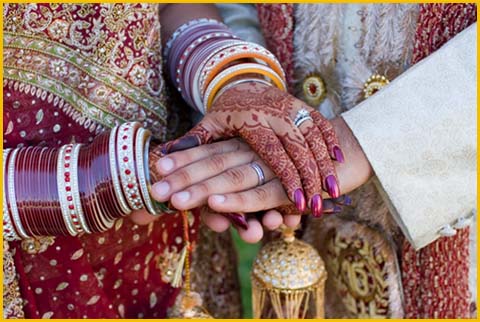
TRADITION OF MEHENDI


Mehndi (Hindi: मेहँदी, Urdu: مہندی) is the application of henna as a temporary form of skin decoration in the Indian Subcontinent, as well as by expatriate communities from these areas. Mehndi decorations became fashionable in the West in the late 1990s, where they are sometimes called henna tattoos. Henna is typically applied during special occasions like weddings and festivals like Diwali, Bhaidooj, Teej and Eid. In some Hindu festivals every woman tries to have Henna done on her hands and feet. It is usually drawn on the palms and feet, where the color will be darkest because the skin contains higher levels of keratin which binds temporarily to lawsone, the colorant of henna. Henna was originally used as a form of decoration mainly for brides.

There is evidence that mehndi as a ceremonial art form originated in ancient India. Intricate patterns of mehndi are typically applied to brides before wedding ceremonies. The bridegroom is also painted in some parts of India, Pakistan, Nepal, Bangladesh and Sudan. In Rajasthan (north-west India), the grooms are given designs that are often as elaborate as those for brides. In Assam, apart from marriage, it is broadly used by unmarried women during Rongali bihu (there’s no restrictions to the married ones). Henna is also common in some gulf states, specially Bahrain, where the night before the wedding night is dedicated to decorating the bride with henna, and called "Henna night".
The use of henna and mehndi by Prophet Muhammad ensured its place in history and its popularity and acceptance among Muslims. In Arabic speaking countries such as Morocco, and some other countries in Central Asia, it is applied on any special occasion. It is done during the seventh month of pregnancy, after having the baby, weddings, engagements, family get-togethers, diwali, as well as on other occasions.